
Process Accountability Chart (PACe) – Scaling Up Framework
The Process Accountability Chart (PACe) is a core tool within the Scaling Up Framework, designed to give business owners absolute clarity over who owns what when it comes to how work gets done.
If your business relies on good people firefighting, knowledge living in heads, or the same issues resurfacing every quarter, the PAC is often the missing piece.
This page explains what the Process Accountability Chart is, why it matters, how it fits into Scaling Up, and how business owners use it to build scalable, resilient organisations.
What is the Process Accountability Chart?
The Process Accountability Chart (PACe) is a simple but powerful one-page view that assigns clear accountability for each core business process.
It answers three questions every scaling business struggles with:
- What are our core processes?
- Who is accountable for each one?
- Are those processes documented, followed, and improved?
The PACe does not describe how the process works in detail. It defines ownership.
Think of it as the bridge between strategy and execution.
Why the Process Accountability Chart Matters
Most businesses don’t fail because of bad strategy. They fail because execution depends on individuals rather than systems.
Without a PACe, businesses experience:
- Inconsistent customer experience
- Bottlenecks that follow people, not roles
- Repeated mistakes and rework
- Leaders stuck in the weeds
- Growth that feels fragile
The PAC introduces process discipline without bureaucracy.
It allows a business to scale without losing control.
How the PACe Fits into the Scaling Up Framework
Scaling Up is built around four key decisions:
- People
- Strategy
- Execution
- Cash
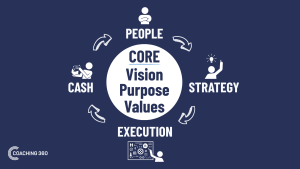
The Process Accountability Chart sits firmly within People, alongside tools such as:
- The One Page Strategic Plan (OPSP)
- Rockefeller Habits / Scaling Up Habits
- Meeting Rhythm
- Key Performance Indicators (KPIs)
The PAC ensures that execution is repeatable, measurable, and owned.
Strategy sets direction. Process ensures consistency. Accountability ensures it actually happens.
Core Processes in a Scaling Business
While every business is different, most PACes include ownership across these areas:
Primary (Customer-Facing) Processes
- Marketing
- Sales
- Operations / Delivery
- Customer Service
Supporting Processes
- Finance
- HR / People
- IT / Systems
- Legal / Compliance
Each process has one accountable owner. Not a committee. Not a shared responsibility.
Accountability means:
- Ensuring the process is documented
- Ensuring it is followed
- Improving it over time
- Reporting on performance
Process Accountability vs Role Accountability
This is where many leadership teams get it wrong.
A job title does not equal process ownership.
For example:
- A Sales Director may own Sales Process
- A Head of Ops may own Delivery Process
- A Finance Manager may own Cash Collection Process
But ownership is about process health, not day-to-day task completion.
This distinction removes ambiguity and stops problems being passed around.
The Benefits of a Well-Implemented PACe
Businesses that properly implement the Process Accountability Chart typically see:
- Faster onboarding of new staff
- Reduced reliance on founders
- Fewer recurring operational issues
- Better cross-department collaboration
- Clearer leadership conversations
- Easier scaling across locations or teams
Most importantly, it creates confidence.
Confidence that the business works without constant intervention.
Common Mistakes with the Process Accountability Chart
- Too many processes – Keep it high level
- Shared accountability – One owner only
- Treating it as a document, not a discipline
- Creating it once and never reviewing it
- Confusing accountability with authority
The PACe is not a tick-box exercise. It’s a leadership tool.
PACe vs Functional Accountability Chart (FACe)
The PACe is often confused with the Functional Accountability Chart (FACe).
They serve different purposes:
- PACe = Who owns processes
- FACe = Who sits in which seats
Used together, they provide clarity across structure and execution.
People sit in seats. Seats own functions. Functions run processes.
Who Should Own the Process Accountability Chart?
The PACe is typically built and maintained by:
- The leadership team
- The CEO or Managing Director
- With facilitation from a certified Scaling Up Coach
External facilitation matters. Leaders are often too close to the business to see where accountability is unclear.
How Kevin Riley Uses the PACe with Scaling Businesses
Kevin Riley is a Certified Scaling Up Coach who works with established business owners to implement the PAC as part of a broader execution system.
Rather than treating it as a standalone tool, Kevin integrates the PAC with:
- Leadership alignment sessions
- Strategy execution rhythms
- KPI ownership
- Decision-making frameworks
The focus is always the same:
Build a business that gives you more life, not less.
When Should You Implement a PACe?
The right time is usually when:
- The business has 10+ employees
- The founder is becoming a bottleneck
- Quality or consistency is slipping
- Growth feels harder than it should
- Problems repeat despite good intentions
In short: when effort is high but leverage is low.
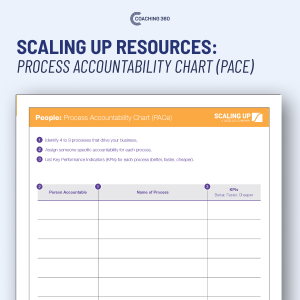
Download the Process Accountability Chart Template
To make this practical, we’ve created a Process Accountability Chart template specifically aligned to the Scaling Up Framework.
You can download it here:
→ Download the Process Accountability Chart Template
Related Scaling Up Resources
To deepen your understanding, explore these related elements of the Scaling Up Framework:
Final Thought
Growth without process creates chaos.
Process without accountability creates frustration.
The Process Accountability Chart solves both.
Used properly, it turns good intentions into consistent execution and gives business owners the confidence to scale.
