
Define ownership. Align your leadership team. Scale with confidence.
Most scaling businesses are doing too much, too messily, with too many people stepping on each other’s toes.
That’s not leadership, it’s survival.
At Coaching 360, we work with ambitious businesses from £1M to £50M+ turnover, large teams who are ready to scale but finding that complexity is slowing them down. One of the tools we use to fix that is the Scaling Up Framework’s Function Accountability Chart, or FACe.
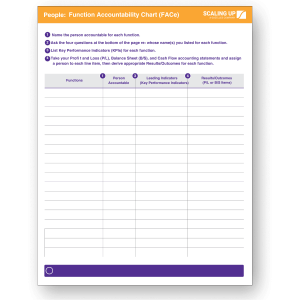
Scaling Up’s Function Accountability Chart (FACe). Digital Download available below.
The Importance of a Function Accountability Chart in Business Scalability
This isn’t a pretty org chart.
It’s your company’s GPS.
When used properly, it brings structure, speed, and sanity to your leadership team and is a vital step when following the Scaling Up Framework.
What Is a Function Accountability Chart (FACe)?
A FACe chart maps the core business functions: Sales, Operations, Marketing, Finance, People, and more—and clearly identifies one person who is accountable for each.
This is about outcomes, not job titles.
If more than one person is accountable, then no one is.
| Function | Accountable Person | Responsibilities Summary |
|---|---|---|
| Sales | Head of Sales | Revenue, pipeline, conversions |
| Operations | COO | Fulfilment, delivery, efficiency |
| Finance | CFO | Cashflow, reporting, forecasting |
| Marketing | CMO | Lead gen, brand, positioning |
Why Every Scaling Business Needs a Team Accountability Structure
As your business grows, so does complexity.
Reporting lines blur. Decision-making slows down. And the leadership team starts spinning its wheels on problems that shouldn’t exist.
You may have heard:
-
“I thought they were doing that…”
-
“Who’s actually responsible for this?”
-
“We’ve got six people in charge of marketing.”
FACe solves that.
It gives your team a shared language around ownership and enables you to:
-
Accelerate decision-making
-
Reduce duplication and confusion
-
Surface overloaded roles and accountability gaps
-
Create clear, fair ownership of outcomes
One of our clients, operating in three countries, struggled with conflicting regional leadership. Using the FACe framework, we redefined responsibilities across markets, clarified escalation paths, and linked each department to specific KPIs. The CEO stepped out of day-to-day firefighting, and the senior team began driving strategic growth.
The Cost of Not Having an Accountability Chart in Your Business
This is where things unravel.
Without a clearly defined accountability structure, most growing businesses experience:
-
Leadership tension: Senior leaders clash over unclear responsibilities.
-
Slow or missed execution: Tasks bounce between departments or stall entirely.
-
Founder bottlenecks: The CEO ends up being the go-to for everything.
-
Demotivated teams: People feel frustrated when they’re blamed for things they don’t own—or unsure what’s actually theirs.
The absence of a FACe leads to friction, inefficiency, and under-performance—not because of bad people, but because of unclear structure.
This is why we don’t just give you the chart—we facilitate the process.
We work with leadership teams to clarify roles, get buy-in, and align around execution.
Strategic Facilitation Services
Step-by-Step Guide to Building Your FACe Chart
We walk our clients through a proven six-step process as part of our Scaling Up Coaching Services:
1. Define Your Core Functions
Sales, Ops, Finance, People, Marketing, Customer Success, IT, etc.
Structure should reflect what the business needs, not just who’s on the team.
2. Assign One Accountable Person Per Function
One name. No committees. No dual ownership.
Clarity starts here.
3. Clarify What Success Looks Like
For each function:
-
Define responsibilities
-
Assign measurable KPIs
-
Clarify key decisions they control
-
Note dependencies with other functions
4. Map the Reporting Structure
Everyone should know who they report to.
Keep span of control between 5–7 direct reports for simplicity.
5. Eliminate Overlap & Gaps
Look for:
-
Two people trying to own the same result
-
Critical areas with no clear ownership
-
Founders wearing too many hats
6. Get Leadership Buy-In
FACe works when the whole team commits.
We facilitate Leadership Team Alignment Workshops to ensure buy-in and ownership.
How to Keep Your FACe Chart Updated and Effective
FACe is a working tool—not a set-and-forget document.
To keep it alive:
-
Review and update quarterly
-
Integrate it into performance reviews
-
Use it in strategic leadership meetings
-
Make it visible across the team
FACe works alongside your other frameworks:
-
EOS
-
One Page Strategic Plan (OPSP)
-
One Page Personal Plan (OPPP)
Free Download: Your FACe Template Pack
We’ve created a complete resource pack to help your team implement FACe:
✔ Editable FACe Spreadsheet
✔ Role Clarity Framework
✔ KPI & Dependency Mapping Template
✔ Step-by-Step Implementation Guide
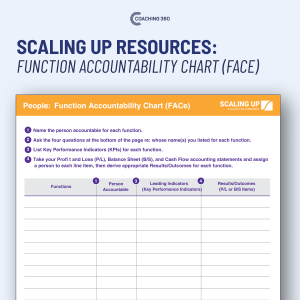
Perfect for leadership teams ready to align and accelerate.
FACe Chart FAQ: Everything You Need to Know
Is this for start-ups or big businesses?
FACe is used by companies from £1M to £50M+ and beyond. The more complex your structure, the more critical it becomes to clarify who owns what.
What’s the difference between an org chart and FACe?
An org chart shows who reports to whom.
FACe shows who owns the outcome. That’s the difference between hierarchy and execution.
Do I need a coach to implement this?
You can use the free pack to start. But most teams get faster, more aligned results when Scaling Up Certified Coach Kevin Riley guides the process of completing a Function Accountability Chart (FACe), especially with cross-functional or multi-location teams.
Final Thought
The opposite of accountability isn’t chaos, it’s mediocrity.
If you want to scale your business with confidence, clarity starts here.
Start with your FACe.
